

Key Highlights

  • Customers expect personalization, but poorly implemented AI often creates irrelevant or mistimed experiences
  • First-party data is the foundation of personalization that actually feels human 
  • High-performing teams personalize a few critical touchpoints before scaling
  • AI works best when paired with human review and iteration
  • Consistent experiences across channels require unified customer data
  • The strongest results come from continuous measurement and optimization

Most personalization today feels like a broken promise. You've seen it: "Recommended for you" emails featuring products you'd never buy, chatbots that loop through the same three responses, or notifications that arrive at exactly the wrong moment. The intent is there, but the execution screams automation.

The problem isn't personalization itself, it's that too many teams treat AI like a plug-and-play solution. They implement recommendation engines or segmentation tools without the data infrastructure, human oversight, or channel coordination needed to make them work. The result? Experiences that feel robotic, not relevant.

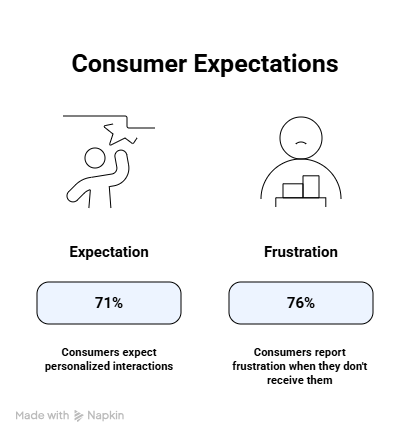
Heading into 2026, the gap between expectation and execution is widening. 71% of consumers now expect personalized interactions, and 76% report frustration when they don't get them. But personalization that misfires, generic, mistimed, or contextually off, is worse than no personalization at all. It erodes trust and signals that you don't actually understand your customer.


The opportunity is clear: companies that get AI personalization right are seeing 5-8x ROI on marketing spend, 40% higher engagement rates, and conversion lifts up to 25%. The difference comes down to how you deploy it, with the right data, the right touchpoints, and the right balance between automation and human curation.

Here's how to make AI personalization work without losing the human touch.

1. Start with First-Party Data, Not Assumptions

Personalization only works when it is grounded in real behavior.

Amazon built its recommendation engine around first-party signals like browsing behavior, purchase history, and engagement patterns. That depth of context is why its suggestions feel relevant instead of random.

Your personalization is only as good as the data feeding it. Third-party data and siloed records produce generic outputs regardless of model sophistication.

Start by auditing what you're actually collecting. Can you track behavior across channels; web, email, app, support interactions? Are you capturing preference signals like product views, content engagement, or feature usage? Most importantly, is that data unified in a way that gives AI a complete view of each customer?

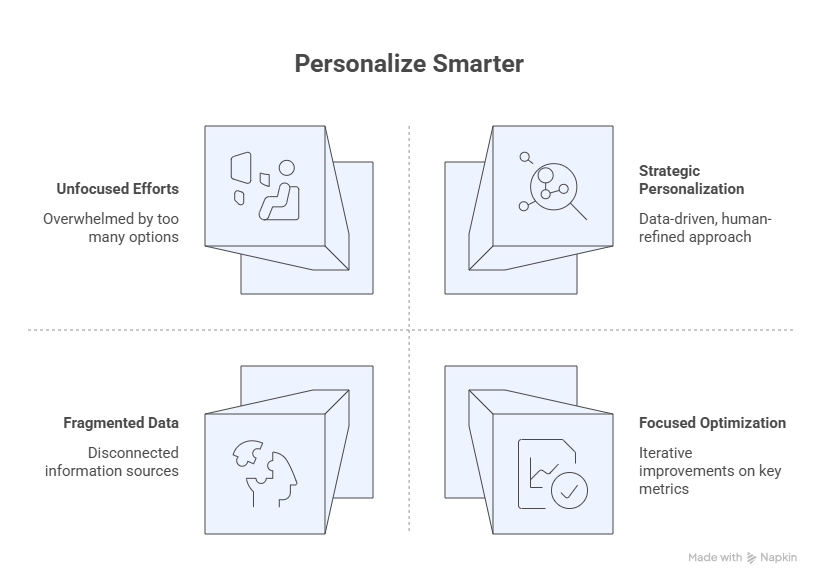
If your data is fragmented, your personalization will be too. Prioritize integration before you scale automation.

2. Personalize High-Impact Touchpoints First

Trying to personalize every interaction at once is one of the fastest ways to fail.

The strongest results come from focusing on one or two moments that clearly influence outcomes. For most businesses, that means email, product recommendations, or in-app messaging.

Netflix focused early personalization efforts on email content and content discovery rather than attempting to customize every surface at once. By tailoring subject lines, thumbnails, and recommendations to viewing behavior, they increased re-engagement without overwhelming users.

Pick the moments that matter most. Measure impact there before expanding.

3. Blend AI with Human Oversight

Here's the most common mistake: treating AI as a set-it-and-forget-it solution. You deploy a recommendation engine or segmentation tool, let it run, and assume it's working. Meanwhile, customers are seeing suggestions that don't make sense or receiving messages that miss the mark entirely.

AI needs human curation to stay relevant. That means reviewing outputs, adjusting algorithms based on performance, and intervening when automation produces generic or tone-deaf results.

Startups in e-commerce and SaaS have proven this model works. By combining behavioral data with human oversight, reviewing product feed recommendations, refining support chat scripts, and adjusting segmentation rules, they've achieved 40% higher engagement, 35% revenue growth, and 30% lower churn.

The sweet spot is using AI to scale what works, while keeping humans in the loop to ensure it stays authentic.


That might mean reviewing weekly performance dashboards, testing variations, or having a team member spot-check personalized messages before they go live.

Automation without curation is a liability. Build review cycles into your process from the start.

4. Deliver Omnichannel Consistency, Not Fragmented Experiences

Personalization breaks down when it's siloed. A customer gets a personalized email about a product they already purchased, or they see different recommendations on your website versus your app. Each touchpoint might be individually optimized, but the overall experience feels disjointed.

Bloomreach addressed this by deploying agentic AI for omnichannel personalization across e-commerce clients. Instead of treating email, web, and mobile as separate systems, they unified customer signals in real time to deliver consistent, tailored interactions across every channel. The result: 82% of users reported 5-8x ROI on marketing spend.

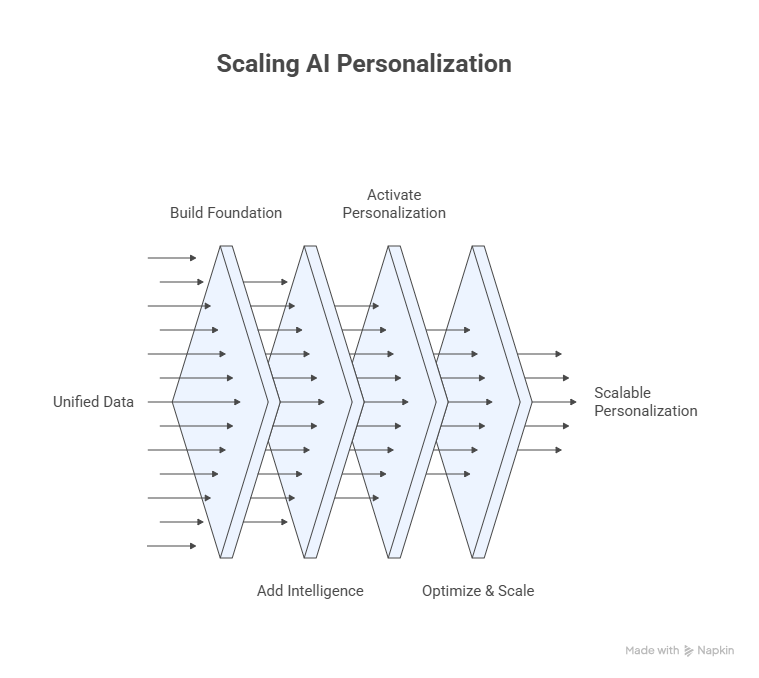
To replicate this, you need a central data layer that syncs customer behavior and preferences across channels. When someone browses a product on mobile, that signal should inform what they see in email, on desktop, and in retargeting ads. When they make a purchase, every channel should update accordingly.

Consistency builds trust. Fragmentation undermines it. Make sure your AI draws from a unified customer view, not channel-specific snapshots.


5. Use Predictive Analytics to Get Ahead of Intent

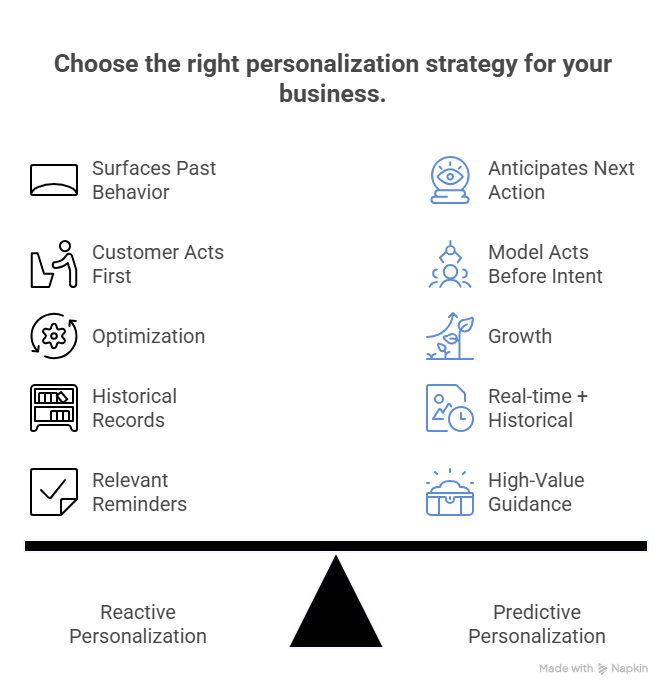
Showing someone what they viewed yesterday is basic personalization.

Anticipating what they are likely to need next is where engagement increases.

Predictive models use historical behavior and real-time signals to surface relevant content before a customer actively searches for it. This approach shapes not only recommendations, but timing, messaging, and creative presentation.

Netflix uses predictive signals to influence not just what content appears, but how it is presented visually to different users. That subtle alignment is why recommendations feel intuitive rather than forced.

Predictive personalization requires clean data and continuous updating. Stale inputs lead to irrelevant outputs.

6. Measure Early, Optimize Often

AI personalization isn't a launch-and-scale project. It's a continuous optimization process. The companies seeing 10-40% engagement gains aren't just deploying better algorithms, they're measuring performance obsessively and iterating based on what the data tells them.

Amazon's recommendation engine generates a 10% lift in sales because the company constantly refines it. They test variations, track click-through rates, monitor conversion, and adjust algorithms based on real performance, not assumptions.

You should do the same. Set clear KPIs before you launch: conversion rate, engagement rate, retention, revenue per customer, or time to value. Then track those metrics weekly, not quarterly.

If a personalized email campaign underperforms, dig into why. Was the segmentation off? Was the timing wrong? Was the content irrelevant? Use that insight to adjust your approach before the next campaign.

Benchmark your results against industry standards,10-40% engagement gains, 5-8x ROI, 25% conversion lifts, but optimize based on your own performance trends.

What worked last quarter might not work next quarter as customer behavior evolves.

Conclusion

AI personalization in 2026 is not about automation for its own sake. It is about relevance at scale.

Customers expect brands to understand them. But understanding is not built from guesswork. It comes from clean first-party data, focused deployment at high-impact touchpoints, unified channel visibility, and continuous optimization.

The companies seeing 5 - 8x ROI and double-digit engagement lifts are not chasing every new AI model. They are operationalizing personalization: reviewing outputs, measuring impact, refining inputs, and scaling what proves effective.

Start small. Choose one high-impact surface. Build the infrastructure correctly. Measure results in revenue terms, not vanity metrics. Then expand.

Personalization only feels robotic when it is careless. When executed thoughtfully, it becomes invisible. It simply feels right.

Frequently asked questions

Personalization becomes intrusive when it surfaces insights customers did not knowingly share or when timing feels off. To avoid this, rely primarily on first-party behavioral data, make recommendations contextually relevant, and avoid over-automation. Clear consent, transparent data practices, and sensible frequency controls are critical.

At minimum, organizations need unified first-party data across web, CRM, email, product usage, and support systems. If behavioral signals are fragmented across tools, AI outputs will be inconsistent and often irrelevant. A central data layer or customer data platform significantly improves personalization quality.

Focus on one or two revenue-critical touchpoints first, typically email campaigns, onboarding flows, or product recommendations. Measure impact before expanding to additional channels. Scaling prematurely often magnifies flaws in segmentation and data quality.

Engagement metrics are useful but insufficient. Track conversion rate lift, revenue per user, average order value, retention rate, and lifetime value changes attributable to personalized experiences. ROI must be tied directly to financial performance, not clicks alone.

Review performance weekly and recalibrate monthly at minimum. Customer behavior shifts quickly, and stale models degrade relevance. Human oversight ensures outputs remain aligned with tone, audience expectations, and business objectives.

Reactive personalization surfaces past behavior. Predictive personalization anticipates next likely action. For organizations seeking growth rather than optimization, predictive models deliver stronger results because they guide customers toward high-value outcomes before intent is fully formed.