
Key Highlights

  • Buyers complete 70% of their purchase decision before speaking to a salesperson, making your website your most active sales asset

  • A 0.1-second improvement in load time lifts conversions by up to 10.1%

  • 75% of buyers judge credibility from design before reading a single word

  • AI search systems are shortlisting vendors before buyers visit any website directly

  • Every month a redesign is delayed, the revenue gap widens

Insight
An outdated website is not a neutral presence. It is an active drain on every marketing and sales investment the business is making.

Insight
The businesses compounding growth consistently treat their website as revenue infrastructure, not a periodic creative project.


Most companies measure their website investment by what it costs to build. The more urgent question is what it costs every month it stays the same.

An underperforming website does not create a neutral experience for visitors. It actively removes revenue from ways that do not show up on any channel report because the damage happens before anyone makes contact.

Why This Matters Heading Into 2026

The role of a business website has shifted fundamentally. It is no longer a digital brochure that supports a sales conversation. It is the primary environment where most buying decisions are formed.

Forrester research shows that 89% of B2B buyers now use AI tools as a primary research channel throughout their buying journey. That means buyers are building shortlists, comparing options, and forming trust assessments before they ever visit a website directly. The sites that appear in those AI-generated responses are the ones structured to be cited and credible. The sites that do not appear have already been removed from consideration before any human interaction takes place.

This is the new baseline. An outdated website is not simply less effective than a modern one. It is structurally invisible at the earliest and most decisive stage of the buyer journey.

The Leads That Disappear Before You Know They Existed

The most immediate cost of an underperforming website is missed inquiries that never register anywhere.

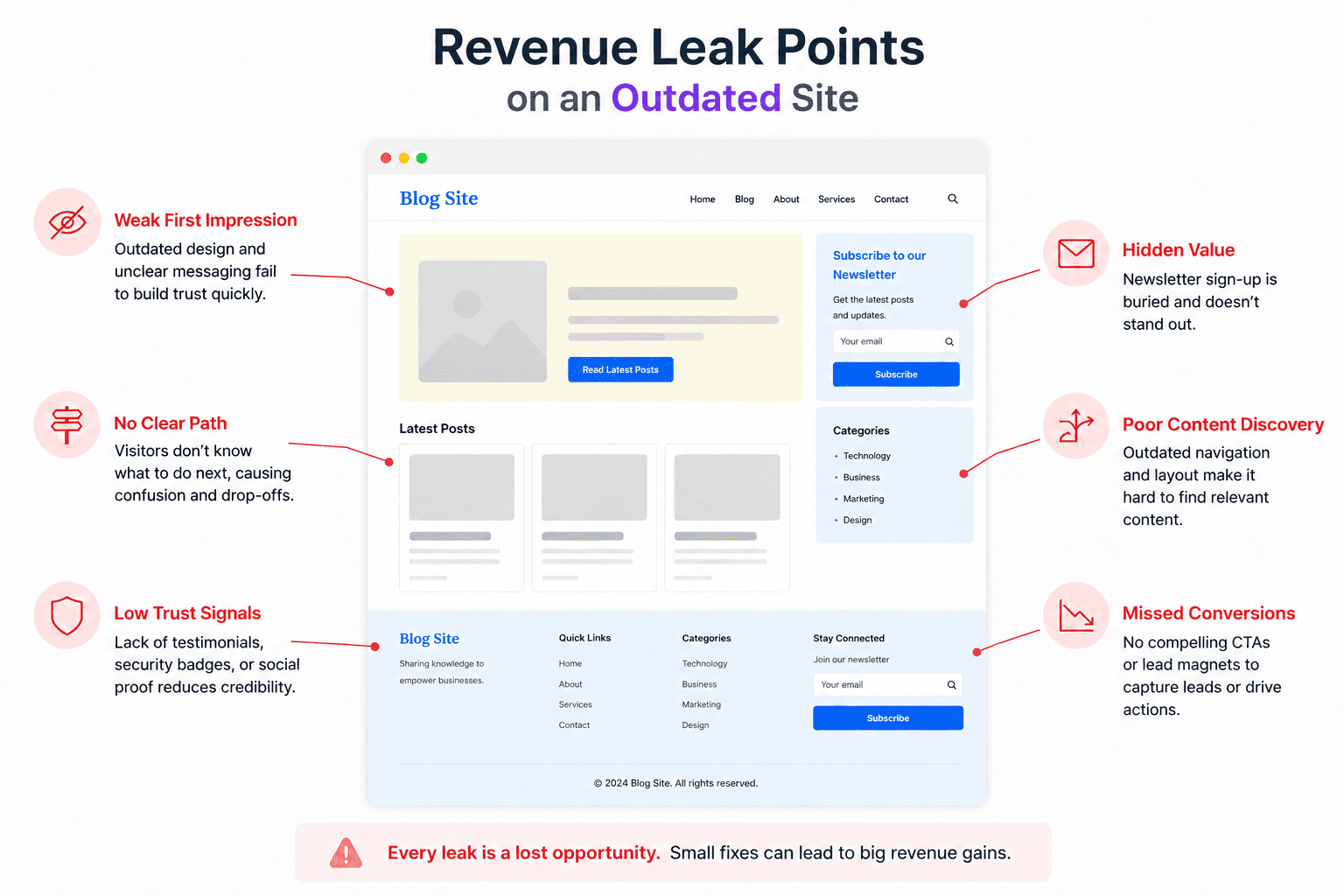
A potential client arrives from a referral, an organic search result, or a link shared in a proposal. They want to understand quickly whether the business is the right fit. If the site is slow, confusing to navigate, or visually inconsistent with the quality of work the company actually delivers, they leave without making contact.

They do not send a message. They do not explain why they left. They move to another option, and the business never knows the visit happened.

The credibility judgment happens before the content is read. Stanford Web Credibility Research found that 75% of consumers judge a business's credibility based on website design. That judgment is formed within seconds of arrival, before a single headline is read or a service page is reviewed.

For mid-market and enterprise buyers evaluating service providers, this judgment is especially consequential. Digital presence functions as a proxy for operational quality. A site that signals 2019 suggests a business that operates like 2019.

Speed Is a Commercial Variable

Page load time is still categorized as a technical concern in most organizations. The revenue data suggests it should be treated as a commercial one.
Website performance and bounce rate analysis

Google and Deloitte analyzed 37 brands across 30 million mobile sessions. A 0.1-second improvement in load time lifted retail conversions by 8.4% and lifted conversions in the travel sector by 10.1%. Average session spend increased by close to 9%.

That is the measured revenue impact of a tenth of a second.

For businesses where most prospective clients conduct initial research on mobile devices, slow load times do not create friction. They end the relationship before it begins. The visitor does not persist through a slow experience. They return to wherever they came from.

Paid Traffic Sent to an Underperforming Website

For businesses running paid media, SEO programs, or email campaigns, an underperforming website creates a compounding problem that rarely surfaces in channel-level reporting.

Each channel reports on its own metrics. Paid media measures click-through rates. SEO measures rankings and organic sessions. Email measures opens and clicks. None of those reports show what happens after the click, which is that the traffic being generated is arriving at a website that cannot convert it.

The spend continues. The leads do not follow. The gap between investment and return grows quarter over quarter, and because the website is not typically owned by the same team running the campaigns, the diagnosis points at the campaigns rather than the infrastructure they are sending traffic to.

The AI Search Visibility Gap

The newest dimension of this cost is one most businesses have not yet measured.

When a buyer searches for a service using ChatGPT, Perplexity, or Google AI Overviews, the AI system synthesizes information from available sources and generates a response. The businesses cited in that response are the ones whose websites are structured to be read, interpreted, and trusted by AI retrieval systems.

A website that is thin on content, slow to load, or lacks clear structure for machine readability is not just harder to find in traditional search. It is absent from AI-generated shortlists entirely. The business does not appear in the response. The buyer never knows it existed as an option.

This is the cost that does not show up in analytics. It happens before a session is ever recorded.

Practical Implementation Guidance

Addressing the cost of an outdated website does not require a complete rebuild in every case. The starting point is measurement.

Establish a clear baseline before making any changes: current conversion rate, average session duration, bounce rate by landing page, and lead volume by traffic source. These numbers reveal where the largest gaps exist and allow improvements to be evaluated against a documented starting point.

Prioritize the pages that receive the most traffic from high-intent sources first. For most businesses, that is the homepage, primary service pages, and any pages linked from paid campaigns or third-party platforms. Speed improvements, clearer calls to action, and stronger trust signals on those pages typically produce measurable results faster than a full site overhaul.

For AI search visibility, structured content matters more than volume. Clear specific pages that answer real buyer questions in a format AI systems can parse and cite are more valuable than large amounts of generic content.

Conclusion

An outdated website is not a neutral presence. It is an active drag on every commercial investment the business makes, from paid media to sales to brand. The traffic arriving from referrals, search, and campaigns encounters a site that cannot convert it, and the cost accumulates invisibly every month.

The businesses compounding growth consistently are not the ones waiting for the perfect moment to rebuild. They are the ones that recognized the website as revenue infrastructure and treated its performance accordingly.

Frequently asked questions

A website is outdated when it fails to meet current buyer expectations around load speed, mobile performance, content clarity, and trust signals. In 2026, AI search readiness has become an additional dimension. Sites that are not structured to be cited by AI retrieval systems are invisible at the earliest stage of most B2B buying journeys.

Visitors who do not quickly find what they need, or who do not trust what they see, leave without making contact. Because this happens before any form is submitted, most businesses significantly underestimate how many leads their website is losing. The damage is real and ongoing but does not appear in standard reporting.

Yes, directly. Research across 30 million mobile sessions found that a 0.1-second improvement in load time lifted conversion rates by up to 10.1% and increased average spend per session by close to 9%. Speed is a commercial variable.

The clearest indicators are a high bounce rate on key landing pages, low average session duration, a conversion rate below 2% on inbound traffic, and a significant gap between traffic volume and lead volume. If paid traffic is arriving but not converting, the website is almost always the constraint.

AI search readiness refers to whether a website is structured so that AI retrieval systems can read, interpret, and cite it in response to buyer queries. Sites without clear structure, specific content, and credibility signals are omitted from AI-generated responses, which is where a growing proportion of B2B buying research now begins.