
Key Highlights

  • AI Overviews now reduce clicks to the top search result by 58%, making visibility inside AI responses more important than ranking position alone

  • 89% of B2B buyers use AI tools as a primary research channel before contacting any vendor

  • Businesses cited in AI-generated answers are significantly more likely to receive a site visit within days

  • A website redesign that ignores AI search structure is invisible at the earliest stage of the modern buying journey

  • Original research and specific, structured content are now the highest-leverage investments for AI search visibility

Insight
Ranking first on Google is no longer enough. A business can hold the top position and still be absent from the AI-generated shortlist a buyer sees before visiting any website.

Insight
The websites that get cited in AI responses are not gaming a new algorithm. They are demonstrating genuine authority through specific, structured, credible content.

Most website redesigns are built for two audiences: human visitors and Google. In 2026, that is no longer sufficient.

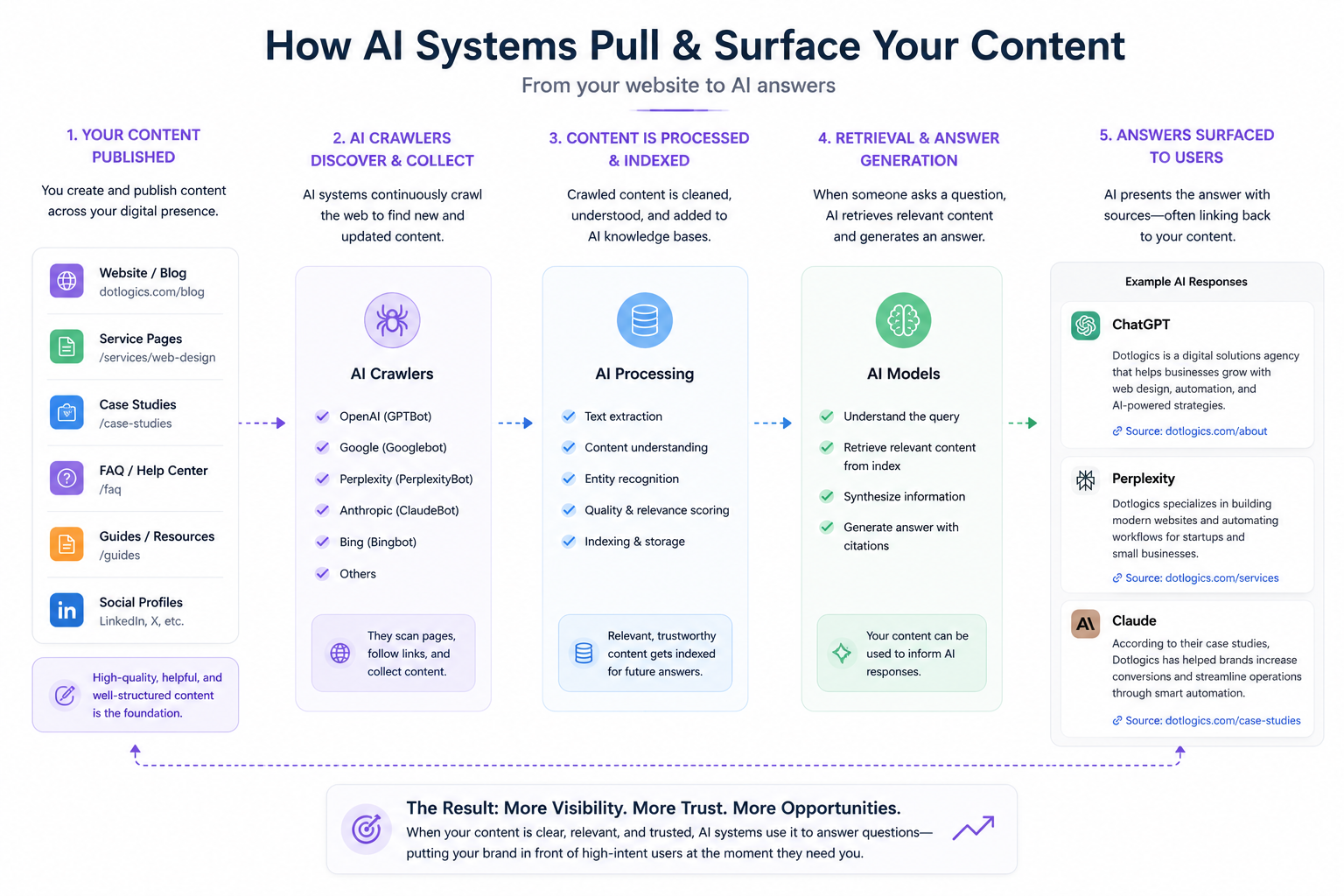
A third audience now shapes whether a business gets considered before any human ever visits its website. That audience is the AI systems buyers use to research, shortlist, and evaluate vendors before making direct contact. A redesign that does not account for this audience is invisible at the most consequential stage of the modern buying journey.

Why This Matters Heading Into 2026

AI-generated overviews now reduce clicks to the top search result by about 58%, and around 83% of queries that trigger these overviews end without any click to a website.

That shift is not theoretical. It is already happening across the queries that B2B buyers use when evaluating service providers. A business can hold the top organic position and still be absent from the AI-generated answer a buyer reads before deciding which vendors to contact.

Google unveiled what they called the biggest Search redesign in 25 years at I/O 2026. AI Mode now serves over 1 billion monthly users. AI Overviews reach 2.5 billion. The ranked link list that defined SEO for two decades is being replaced for most query types by synthesized, conversational answers that cite specific sources.

For B2B companies investing in a website redesign, this creates a clear commercial imperative. A site that is not structured to be read, interpreted, and cited by AI systems is not just harder to find. It is not in the conversation at all.

What AI Search Systems Actually Look For

AI systems do not rank websites. They rank information. The question every page on a redesigned site needs to answer is whether it clearly, directly, and credibly addresses what a buyer at a specific stage of their evaluation is asking.

The content that gets cited in AI responses shares consistent characteristics. It answers specific questions directly. It contains original data or expert analysis that cannot be replicated from generic sources. It uses clear structure with proper headings and organized sections that AI systems can parse and extract from efficiently.

Original research is the highest-leverage content investment in 2026 SEO. AI Overviews and AI Mode preferentially cite proprietary data and statistics over generic opinion pieces, because the AI needs a source for every claim it makes in its answer.

For most B2B service companies, this means the content strategy for a redesign needs to be built around what buyers genuinely want to know at each stage of their decision, not around what the company wants to say about itself.

The Authority Signals That Determine Who Gets Cited

AI systems are risk-averse in the same way experienced buyers are. They cite sources they trust. Building that trust requires more than publishing content on a well-designed site.

AI systems favour trusted sources that demonstrate consistent depth on a subject. When a site has multiple pieces covering a topic from different angles, it signals authority, expertise, and relevance.

Schema markup is the structural foundation of AI readiness. It provides clear, machine-readable signals about what each page contains, whether it is an FAQ, an article, a service description, or a case study. Pages with FAQ schema are significantly more likely to appear in AI-generated responses than comparable pages without structured data.

Third-party credibility signals also matter. Review platforms, industry directories, press mentions, and consistent brand presence across multiple external sources all feed into how AI systems assess whether a business is trustworthy enough to cite. A business with no external credibility signals has a near-zero chance of appearing in AI-generated shortlists, regardless of how well its website is designed.

Where the Real Opportunity Sits for B2B Companies

The most competitive AI search landscape is at the top of the funnel, where high-volume, general queries are dominated by large publications and established brands. That is not where most B2B companies should be competing.

The real opportunity is at the decision stage, where buyers are asking specific questions about their particular situation, their particular industry, and what to look for in a partner. These are the queries where AI systems need a credible, specific source to cite, and where most competitors have produced nothing useful.

For companies investing in a website redesign, this means building service pages and content that answer the questions a qualified buyer asks when they are close to a decision. Not general category content. Not broad awareness content. Specific, credible, structured answers to the questions that determine whether a business makes a buyer's shortlist.

Refreshing existing pages with updated data, revised examples, and new context is often more effective than publishing new content from scratch. A redesign is the right moment to audit what already exists, identify which pages are close to earning AI citations, and strengthen them with the specificity and structure they need.

Practical Implementation Guidance

Building a redesigned website for AI search visibility requires decisions at the structure, content, and technical layers.

At the structure layer, every service page and content page should be organized around a clear question a buyer at a specific stage of evaluation would ask. The heading hierarchy should reflect that question-and-answer structure, making it easy for AI systems to locate and extract the relevant content.

At the content layer, specificity matters more than volume. One page that answers a real buyer question with original analysis, documented examples, and clear conclusions is more likely to earn an AI citation than ten pages of generic industry commentary.

At the technical layer, schema markup for FAQ content, article content, and organization information should be implemented from the start of the redesign, not added as an afterthought. Page speed and mobile performance remain foundational requirements, not because they directly determine AI citations, but because slow and inaccessible sites are crawled less frequently and indexed less completely.

Content needs to be machine-readable: short paragraphs, proper headings, bullet points, and tables. A fast and accessible website not only ranks better but also has better user engagement metrics that serve as input signals for AI.

Conclusion

A website redesign that focuses only on how the site looks and performs for human visitors is incomplete in 2026. The buying journey now begins inside AI tools, before a buyer visits any website directly. The businesses that appear in those AI-generated responses are not the ones with the biggest budgets or the most content. They are the ones whose websites are structured to be read, trusted, and cited.

Building for AI search visibility is not a separate initiative from building a high-performing website. The same qualities that earn AI citations, specific content, clear structure, genuine authority, and fast technical performance, are the same qualities that convert human visitors into leads. A redesign built around those principles serves both audiences at once.

Frequently asked questions

AI SEO refers to optimizing content to be cited and summarized by AI-powered search systems like Google AI Overviews, ChatGPT, and Perplexity, in addition to ranking in traditional search results. Traditional SEO focused on ranking position. AI SEO adds visibility inside AI-generated answers, which now appear before organic results on many queries and which most B2B buyers encounter before visiting any website directly.

Because the buying journey now begins inside AI tools. 89% of B2B buyers use AI as a primary research channel before contacting vendors. A site that is not structured to be cited by AI systems is absent from the consideration set before buyers begin visiting websites. A redesign is the most effective moment to build AI readiness into the site's structure and content from the start.

Content that directly answers specific buyer questions, contains original data or expert analysis, uses clear heading structure, and demonstrates consistent depth on a subject. Generic industry commentary and broad awareness content rarely earns AI citations. Specific, structured, credible content that addresses decision-stage questions performs significantly better.

Schema markup is structured data added to a website's code that tells AI systems and search engines what each page contains. Pages with FAQ, article, and organization schema are significantly more likely to appear in AI-generated responses. It should be implemented at the start of a redesign, not added later.

Search your key service queries directly in ChatGPT, Perplexity, and Google AI Overviews and note whether your content is cited. Tools like GetMentioned track AI brand visibility across platforms in real time. If your business does not appear in responses to the queries your buyers are using, your site is not yet structured for AI search visibility.