Key Highlights

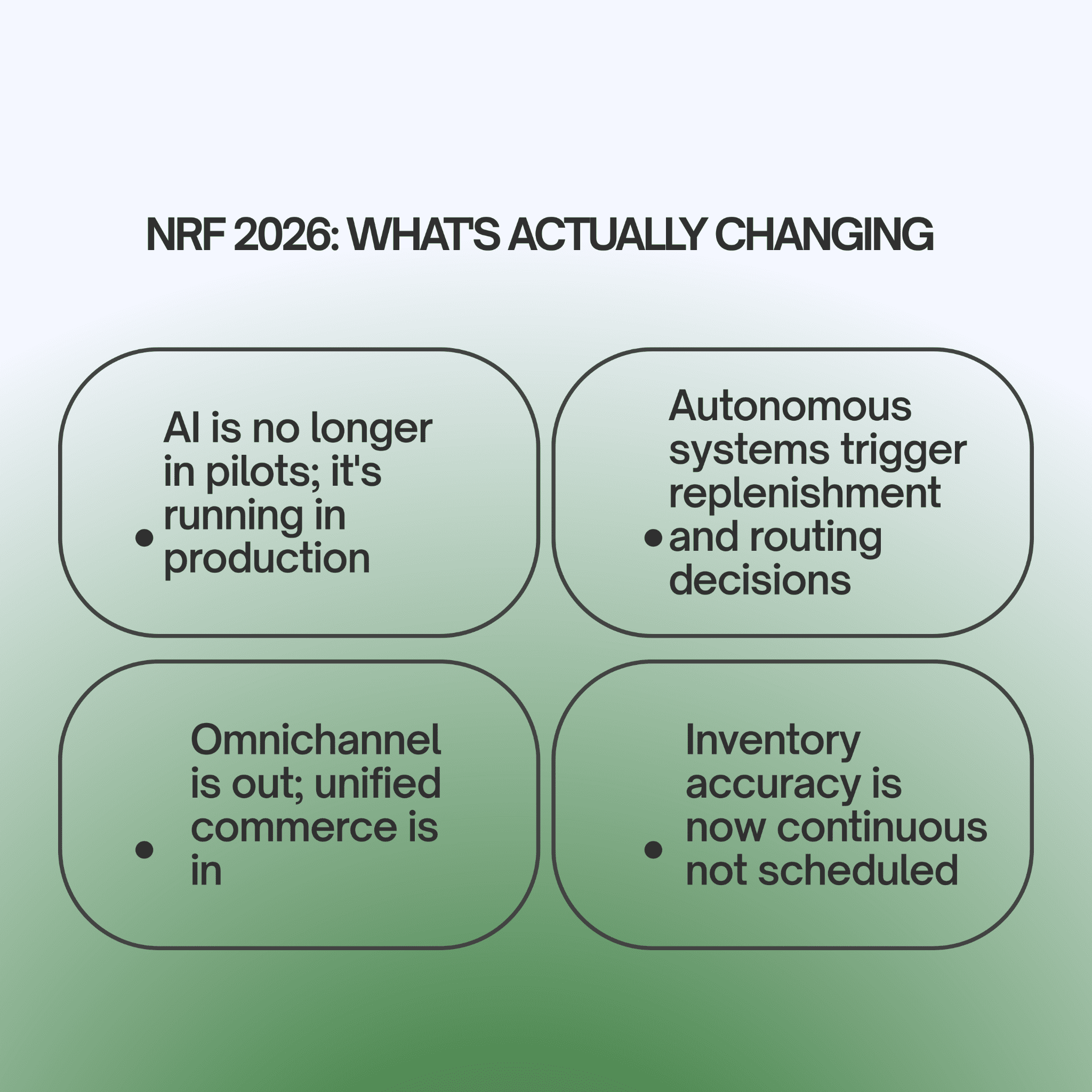
  • US retailers arrived at NRF 2026 with AI already deployed in core operations, not pilots.

  • Autonomous systems are now triggering replenishment, labor adjustments, and routing decisions.

  • Retailers are replacing omnichannel thinking with unified commerce infrastructure.

  • Inventory accuracy is shifting from scheduled counts to continuous verification.

  • Store automation is being designed to reduce friction for staff, not replace them.

  • Leadership focus is moving from experimentation to governance and execution discipline.

NRF 2026 marked an inflection point, not because retailers discovered something new, but because experimentation finally gave way to execution. The shift was subtle but consistent across sessions and closed-door discussions. Large US operators arrived with production systems, not pilot decks. The conversation moved from “Can this work?” to “How do we scale what already works without breaking operations?”

For leadership teams navigating tight margins, labor constraints, and rising complexity, that distinction matters. The gap between viable operational investments and expensive distractions has never been clearer.

What's Actually Changing Operations

AI That Acts, Not Just Advises

The most meaningful shift at NRF was not the presence of generative AI, but its role. Retailers are embedding autonomous decision-making directly into core workflows rather than layering AI on top of existing processes.

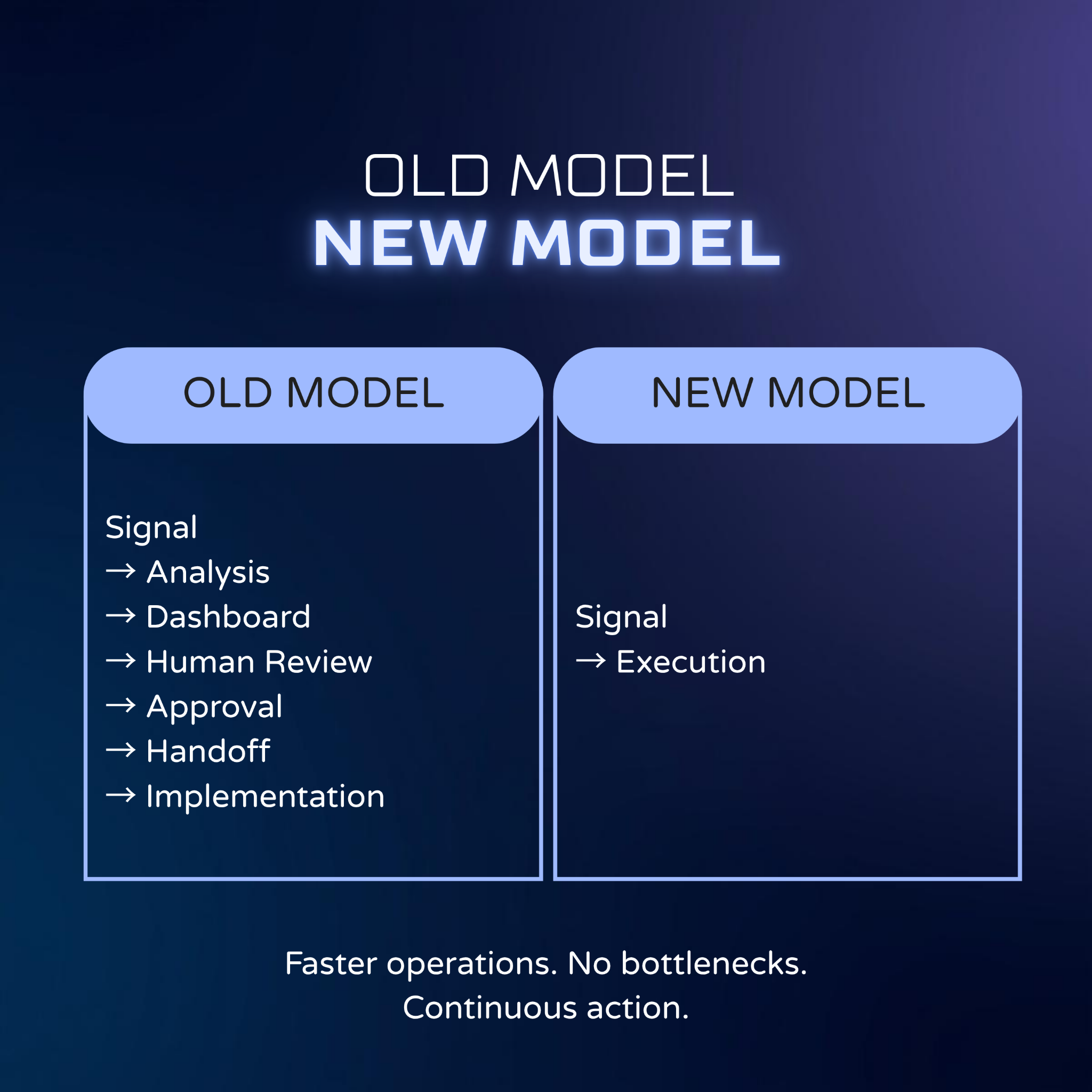
Instead of generating recommendations that require human review, systems are initiating replenishment, adjusting labor allocations, and rerouting fulfillment based on live conditions. The operational benefit is speed and continuity. Insights no longer wait in dashboards for action. They trigger action.

This collapses a chain that has long slowed retail execution: analysis, approval, handoff, implementation. When systems move directly from signal to execution, teams stop optimizing functions in isolation and start optimizing outcomes.
Unified Commerce as Foundational Infrastructure

Operators have quietly moved on from the term “omnichannel.” What replaced it is a more pragmatic idea: commerce as a single, interoperable system.

Stores, warehouses, and digital touchpoints are being treated as nodes in a unified fulfillment and inventory grid. This shift isn’t driven by experience design; it’s driven by operational necessity. You cannot route orders, manage exceptions, or automate replenishment if systems don’t share a common data model.

Initiatives like the Universal Commerce Protocol reflect this reality. They are less about innovation and more about formalizing what large retailers have already built internally: infrastructure that allows agents, human or automated, to transact across environments without brittle integrations.

Home improvement and grocery operators highlighted a critical dependency here. Product data consistency is no longer a marketing concern. It’s an operational requirement. Without complete, structured data, automation breaks down before it starts.

Inventory Accuracy Without Theater

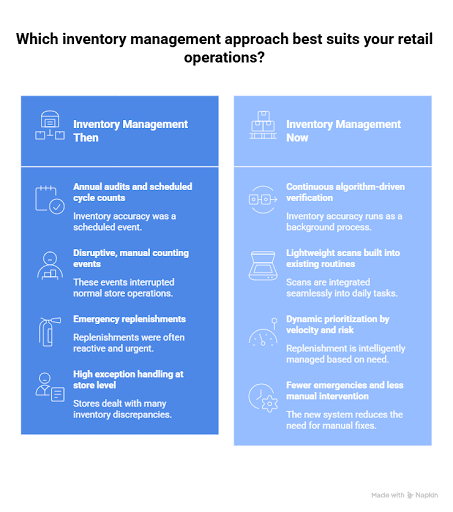
Inventory management is moving from episodic counting to continuous verification.

Instead of annual audits or scheduled cycle counts, retailers are prioritizing inventory checks dynamically based on velocity, shrink risk, and revenue impact. Associates perform lightweight scans as part of existing routines using familiar mobile devices. Algorithms decide where attention is needed.

The operational consequence is fewer emergency replenishments, fewer last-minute substitutions, and less manual exception handling at the store level. Inventory accuracy becomes a background process rather than a disruptive event.

This is inventory management reimagined as a continuous background process rather than a scheduled event.
Store Automation That Doesn't Scare Staff

A recurring theme at NRF was “quiet tech.” Automation designed to fade into workflows rather than dominate them.

Associates interact with tools that resemble consumer apps, visual guidance, familiar gestures, minimal training. The goal is not replacement, but leverage. Automation absorbs repetitive cognitive load so staff can focus on exceptions and customer interaction.

In a constrained labor market, adoption matters as much as capability. Tools that require retraining or disrupt established routines face resistance. Tools that feel intuitive earn trust quickly.

Content Generation as Infrastructure, Not Marketing

AI-generated content appeared frequently, but the framing has shifted. This is no longer about copy quality. It’s about scalability.

Retailers are using AI to generate and maintain consistent product data across millions of SKUs. That data feeds search, recommendations, fulfillment logic, and store operations. Manual creation cannot keep pace with catalog growth or channel expansion.

Leaders should treat this as infrastructure investment. The value comes from making product data usable everywhere, not from marginally better descriptions.

Experiential Retail Backed by Operational Rigor

The store-as-experience-center isn't new. What's new is treating it as an operational model supported by automation rather than a staffing-intensive aspiration. Retailers are using AI to analyze foot traffic, personalize in-store interactions, and optimize layouts; while using the automation mentioned above to free staff for those higher-touch activities.

This works when the back-end is efficient enough that the front-end can be human. NRF sessions stressed the balance: automation handles the mechanical, humans handle the meaningful. But that balance only functions if systems are reliable and staff aren't drowning in operational busywork.

The shift represents a pragmatic acknowledgment. Customer retention matters. Labor is expensive and scarce. Technology can create the conditions where human interaction adds value instead of just keeping the operation running.


What Leadership Teams Are Deprioritizing

Just as important as what's gaining traction is what's being quietly abandoned.

Retail media's operational promise has stalled. While still discussed as a revenue opportunity, panels revealed persistent challenges with data fragmentation and ROI measurement. Outside a handful of major players, the infrastructure required to scale retail media networks hasn't materialized. It's a growth story without operational legs for most retailers.

Circularity and sustainability, once positioned as strategic imperatives, reverted to economic pragmatism. Discussion focused on cost management and regulatory compliance, not aspirational transformation. Previous pilot programs lacked execution evidence. Vendors offered vague roadmaps. Leadership teams are treating sustainability as table stakes, not differentiation.

Standalone generative AI pilots are being abandoned at scale. The show floor featured dozens of demos. The keynotes featured warnings: AI fails in production when organizations haven't rewired processes, addressed edge cases, or integrated loss prevention considerations. Retailers who've moved beyond pilots emphasized that deployment isn't a technology problem, it's an organizational design problem.

The Next 12–18 Months

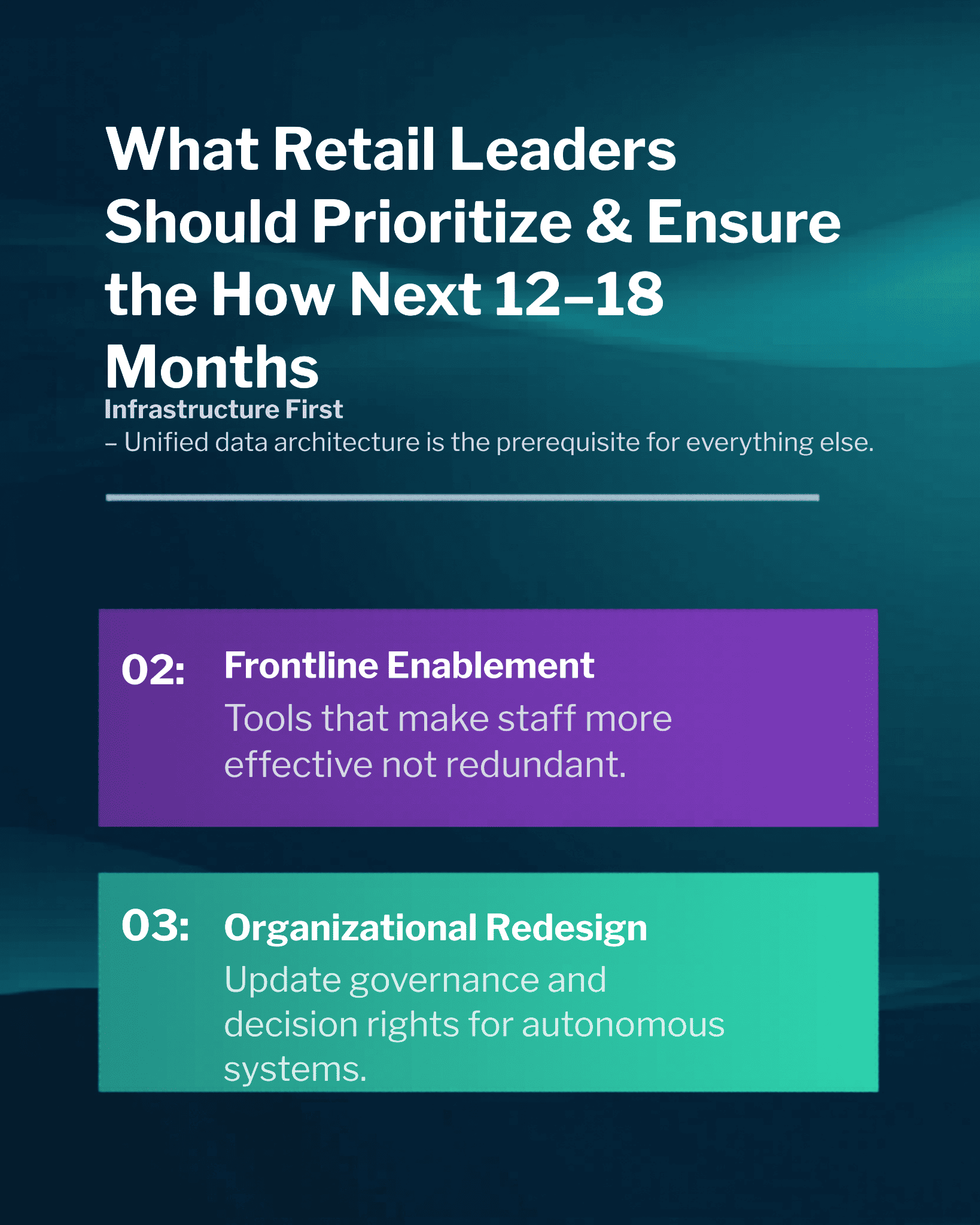
Leadership teams should focus on three operational areas:

Infrastructure first. Unified data architectures and interoperable systems aren't glamorous, but they're the prerequisite for everything else. If your inventory systems can't support real-time visibility across all channels, agentic AI and autonomous fulfillment remain theoretical. Investment here determines what's possible later.

Frontline enablement over replacement. Technology that makes current staff more effective will outperform technology that eliminates roles. Tools should reduce friction, not add complexity. If implementation requires significant training or disrupts existing workflows, it's probably wrong.

Organizational redesign for automation. Policy frameworks, governance structures, and decision rights all need updating when systems start making autonomous operational choices. This isn't a technology workstream, it's a leadership workstream. The retailers executing well at NRF had clearly thought through what decisions they're comfortable delegating to algorithms and what guardrails those algorithms need.


Conclusion

NRF 2026 clarified what separates operational execution from strategic theater. The retailers who've stopped experimenting and started deploying share a pattern: they've made unglamorous infrastructure investments, they've prioritized staff leverage over staff reduction, and they've accepted that technology transformation requires organizational transformation.

The future isn't coming. For the operators who matter, it's already here, running in production, handling exceptions, and generating results. The question for everyone else is how quickly they can close the gap.

Frequently asked questions

Retailers moved from AI experimentation to operational deployment. The focus shifted from pilot programs to production systems embedded in core workflows.

Agentic AI refers to systems that move from insight to execution automatically. Instead of generating recommendations, they trigger actions such as replenishment, labor adjustments, or fulfillment routing.

Because leading operators now treat commerce as unified infrastructure rather than separate channels. Stores, warehouses, and digital platforms operate as interconnected nodes within a shared data architecture.

Inventory accuracy is shifting from scheduled counts to continuous verification. Algorithms identify where attention is needed, reducing emergency replenishment and exception handling.

As systems gain autonomy, leadership must define decision rights, escalation paths, and guardrails. AI deployment is now an organizational design challenge, not just a technical one.

Standalone AI pilots without integration, fragmented retail media initiatives, and sustainability programs lacking operational backing are receiving less strategic focus.

Infrastructure modernization, frontline enablement tools, and organizational readiness for automation. Unified data and clear governance frameworks determine scalability.