
Key Highlights

  • Traditional chatbots fail by deflecting tickets instead of routing leads.
  • AI chatbots integrated with CRMs respond in seconds and save sales reps 5+ hours per week.
  • B2B companies see 40% more qualified leads and 30% shorter sales cycles with AI chatbots.
  • Effective AI asks qualifying questions, detects buying signals, and syncs every interaction to your CRM.
  • Implementation begins by mapping funnel gaps and building qualification logic—not picking tools first.

Most AI chatbots for B2B customer support are glorified FAQ widgets. They answer surface-level questions, deflect support tickets, and disappear the moment a real conversation starts. That's not customer support. And it's definitely not revenue infrastructure.

If your chatbot isn't qualifying leads, routing intent, and feeding your CRM with context, it's not doing anything your team can't ignore. By 2026, the gap between companies using conversational AI as a support band-aid and those using it as a revenue engine is widening fast.

This isn't about being early to AI. It's about understanding what actually converts.

Why Most AI Chatbots for B2B Don't Drive Revenue

Traditional support chatbots were built to reduce ticket volume, not accelerate pipeline. They greet visitors, answer basic questions, and hand off to a human when things get complicated. The problem? In B2B, complications are where revenue lives.

A visitor asking about enterprise pricing isn't looking for a knowledge base article. They're evaluating whether your solution fits their scale, budget, and timeline. If your chatbot can't detect that intent, qualify the conversation, and route it to the right rep with context, you've just lost velocity.

Speed matters, but speed without qualification is noise. A chatbot that responds in seconds but can't tell the difference between a tire-kicker and a $500K opportunity isn't saving your team time. It's creating more work.

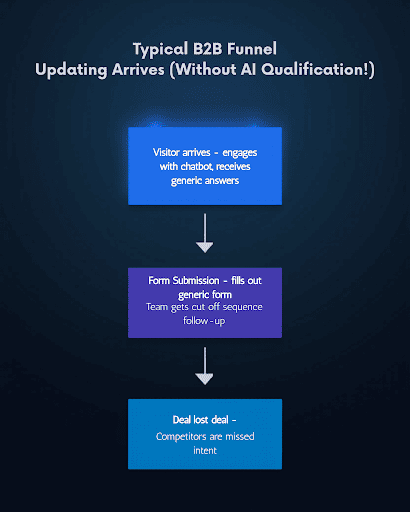
Here's what happens in most B2B funnels: a high-intent prospect visits your site, interacts with a chatbot, gets generic answers, fills out a form, and waits. By the time your sales team follows up hours or days later, they've already talked to two competitors. You didn't lose because your product wasn't good enough. You lost because your system was too slow.

Typical B2B Funnel Breakdown

Stage

Action

Outcome

Visitor Arrives

Engages with chatbot

Generic answers given

Form Submission

Prospect fills out generic form

Long wait for sales follow-up

Sales Follow-Up

Sales team contacts prospect

Competitors already engaged

Result

Lost deal due to slow response

Revenue opportunity missed

The Real Cost of Missed Intent

B2B buyers don't wait. They move through multiple vendor conversations simultaneously, and whoever delivers clarity and next steps first usually wins the deal. When your chatbot can't detect intent or your CRM doesn't capture conversational context, your reps are flying blind.

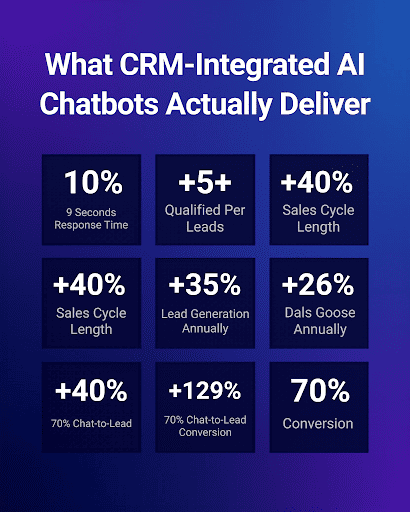
CRM-integrated chatbots reduce response times from hours to seconds and eliminate manual data entry, saving 5+ hours per sales rep per week. That's not a convenience upgrade. That's reclaiming an entire workday.

But the bigger issue isn't time. It's prioritization. Without intent scoring, your team treats every inquiry the same. High-fit prospects get stuck in the same queue as unqualified traffic. Your best reps waste cycles on leads that were never going to close while real opportunities cool off.

Impact of CRM-Integrated AI Chatbots on Sales Productivity

Metric

Impact

Response Time Reduction

Hours → Seconds

Time Saved Per Rep

5+ hours / week

Qualified Leads Increase

+40%

Sales Cycle Reduction

-30%


MongoDB figured this out early. They use an AI chatbot to qualify early-stage leads, score intent based on conversational inputs, and route high-intent conversations to sales reps with full context. No leakage. No guessing. No wasted follow-up on leads that weren't ready.

What Successful AI Chatbots Do Differently in 2026

The chatbots that convert aren't smarter because of better AI. They're smarter because they're connected to the systems that matter: your CRM, your lead scoring model, your routing logic, and your follow-up workflows.

Here's the shift: conversational AI isn't a support tool anymore. It's a qualification and acceleration layer. This is the defining shift in AI customer support for 2026: chatbots are now lead qualification engines, not ticket deflectors.

Conversational AI refers to CRM-connected chat systems that use natural language processing to qualify leads, detect buying signals, and route conversations based on intent, not just answer predefined questions.

When a prospect engages, the chatbot doesn't just answer questions. It asks them. It pulls in firmographic data. It detects buying signals. It qualifies based on role, company size, use case, and urgency. Then it routes the conversation to the right rep, books the meeting, and syncs everything to your CRM before the prospect even leaves the page.

Wrike deployed this with Drift. Real-time lead qualification and routing increased qualified lead volume and cut response times to near zero. The result wasn't more conversations. It was better ones.

B2B software and manufacturing companies using CRM-integrated AI chatbots report up to 40% increases in qualified leads and 30% reductions in sales cycle length. Those aren't optimistic projections. Those are benchmarks from teams who stopped treating chatbots like support widgets and started treating them like pipeline infrastructure.

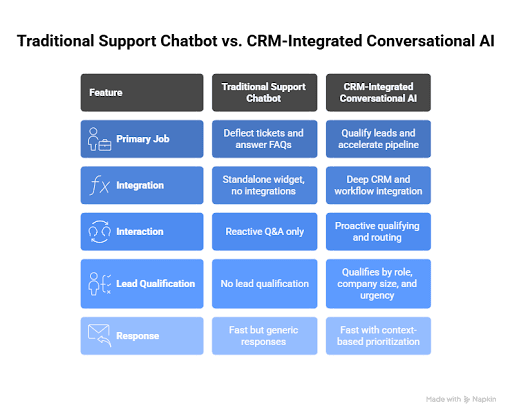
Conversational AI vs Traditional Support Chatbot

Feature

Traditional Support Chatbot

CRM-Integrated Conversational AI

Primary Function

Deflect tickets / answer FAQs

Qualify leads & accelerate pipeline

Integration

Standalone FAQ widget

Deep CRM & workflow integration

Interaction Focus

Reactive Q&A

Proactive qualifying & routing

Lead Qualification

None

Role, company size, urgency-based

Response Speed

Fast but generic

Fast with context-based prioritization

CRM Integration Is Where Conversion Happens

Most B2B chatbots fail because they aren’t connected to CRM systems. Without real-time intent capture, lead scoring, and routing, chatbot conversations lose context and momentum. Conversion improves only when conversational AI is embedded directly into revenue workflows.

A chatbot without CRM integration is just a conversation that dies in a silo. Your rep gets a notification. Maybe they check it. Maybe they don't. Either way, the context is lost, the follow-up is delayed, and the lead moves on.

CRM-integrated chatbots turn every interaction into actionable pipeline data. CRM-connected conversational workflows change the entire motion. Every interaction is logged. Intent signals are captured. Lead scores update in real time. Your rep doesn't start from scratch. They start with context, momentum, and a warm handoff.

HubSpot data shows CRM-connected conversational workflows close 36% more deals and generate 129% more leads annually. That's not because the chatbot is doing the selling. It's because the chatbot is doing the work that used to slow your team down: capturing data, qualifying intent, and routing conversations before momentum dies.

Across B2B implementations, the benchmarks are consistent:

22–25% conversion rate lift

28–38% improvement in lead-to-opportunity 

Chat-to-lead rates up to 70%

16–18% customer satisfaction improvement

These aren't promises. They're what happens when you stop bolting AI onto broken processes and start building it into your revenue system.

How AI Chatbots Improve Sales Productivity Without Adding Headcount

Your sales team doesn't need more leads. They need better ones, faster. AI chatbots don't replace reps. They remove the friction that keeps reps from doing what they're good at: closing deals.

Manual data entry, delayed follow-ups, unqualified pipeline, and time spent on discovery calls that should have been disqualified in the first interaction; these are the productivity killers. A CRM-integrated chatbot eliminates all of them.

Your reps stop chasing cold leads. They stop logging notes manually. They stop waiting for prospects to reply to generic emails. Instead, they get warm handoffs with full context, intent scores, and next steps already in motion.

That's how you scale without hiring. You give your best people better leverage.

Implementation Principles That Actually Work

Implementing AI chatbots for lead qualification starts with mapping your funnel breaks—where conversations stall, where intent gets missed, and where leads leak—then building conversational flows that qualify based on role, company size, urgency, and use case.

Start With Your Funnel, Not The Tool

Don't start with the chatbot. Start with your funnel. Map where conversations stall, where intent gets missed, and where leads leak. Then design the conversational flow to fix those breaks.

Build Qualification Logic Into Every Conversation

Your chatbot should ask questions that qualify, not just answer questions that deflect. Build your logic around role, company size, urgency, and use case. Route aggressively based on intent, not just availability.

Connect Your CRM From Day One

Connect everything to your CRM from day one. If the conversation doesn't sync, the data doesn't exist. If the data doesn't exist, your team can't act on it.

Train Your Team on Speed and Context

Train your team to treat chatbot handoffs like inbound calls, not form fills. Speed matters. Context matters more. If your reps are starting conversations from scratch after a chatbot interaction, your implementation failed.

Test Your Routing Logic Relentlessly

Test your routing logic relentlessly. High-intent prospects should never hit a dead end. Low-intent traffic should never clog your pipeline. The system should make those decisions automatically.

Conclusion

By 2026, AI chatbots aren't customer support tools. They're revenue infrastructure. The companies winning with conversational AI aren't the ones with the fanciest interfaces. They're the ones who connected the system to their CRM, qualified intent in real time, and gave their sales teams better leverage.

If your chatbot is still answering FAQs and deflecting tickets, you're not behind on AI. You're behind on systems thinking. The opportunity isn't to adopt conversational AI. It's to build it into the way your team captures, qualifies, and converts revenue.

Your prospects are already having these conversations. The question is whether your infrastructure is ready to turn them into pipelines.

Frequently asked questions

B2B chatbots in 2026 handle complex, messy workflows involving multiple stakeholders, long sales cycles, intricate pricing models, compliance, security reviews, and legacy internal systems. Unlike B2C bots that answer simple queries like order tracking or password resets, B2B bots must manage detailed questions such as SSO support, SOC 2 compliance, data migration without downtime, and API rate limits.

Effective B2B chatbots share these traits: they are grounded in the company's real source of truth rather than marketing content; start tightly scoped with one job done well before expanding; can take actions like creating tickets or updating CRM; have strict guardrails for pricing and legal commitments; are measurable through metrics like resolution rate and lead conversion; and provide smooth human handoffs that feel collaborative rather than punitive.

The five use cases that pay off include: 1) Support deflection for Tier 1 and Tier 1.5 issues like setup questions and basic billing within safe boundaries; 2) Sales qualification that answers product questions instantly and books meetings without annoying serious buyers; 3) Customer success enablement inside the product offering contextual help, feature explanations, and integration support; 4) Internal enablement bots for sales, support, onboarding, and IT teams; and 5) Other practical workflows that tie back to pipeline and revenue.

A good support deflection bot focuses on fast triage and accurate self-service by asking 2 to 4 clarifying questions, citing documentation sources, offering the next best action instead of multiple options, and creating tickets with context when needed. It handles setup questions, simple troubleshooting steps, documentation navigation, incident updates, and basic billing queries while escalating complex issues like bugs or enterprise security concerns promptly.

An ideal sales qualification bot answers product questions instantly, guides prospects to suitable plans without overselling, asks only one qualification question at a time when necessary, and can book meetings with routing rules based on territory or segment. For enterprise buyers, it adopts a concise 'solutions engineer' tone instead of a friendly assistant style to respect their seriousness. Key metrics include chat-to-meeting conversion rates and speed to first human touch.

Human handoff is crucial because it ensures complex or sensitive issues beyond the bot's scope receive expert attention smoothly. The best bots escalate conversations like supportive teammates rather than making users feel punished or frustrated. This seamless transition maintains customer satisfaction (CSAT), improves escalation accuracy, reduces churn risk, and upholds trust in both support and sales processes.