AI That Acts, Not Just Advises
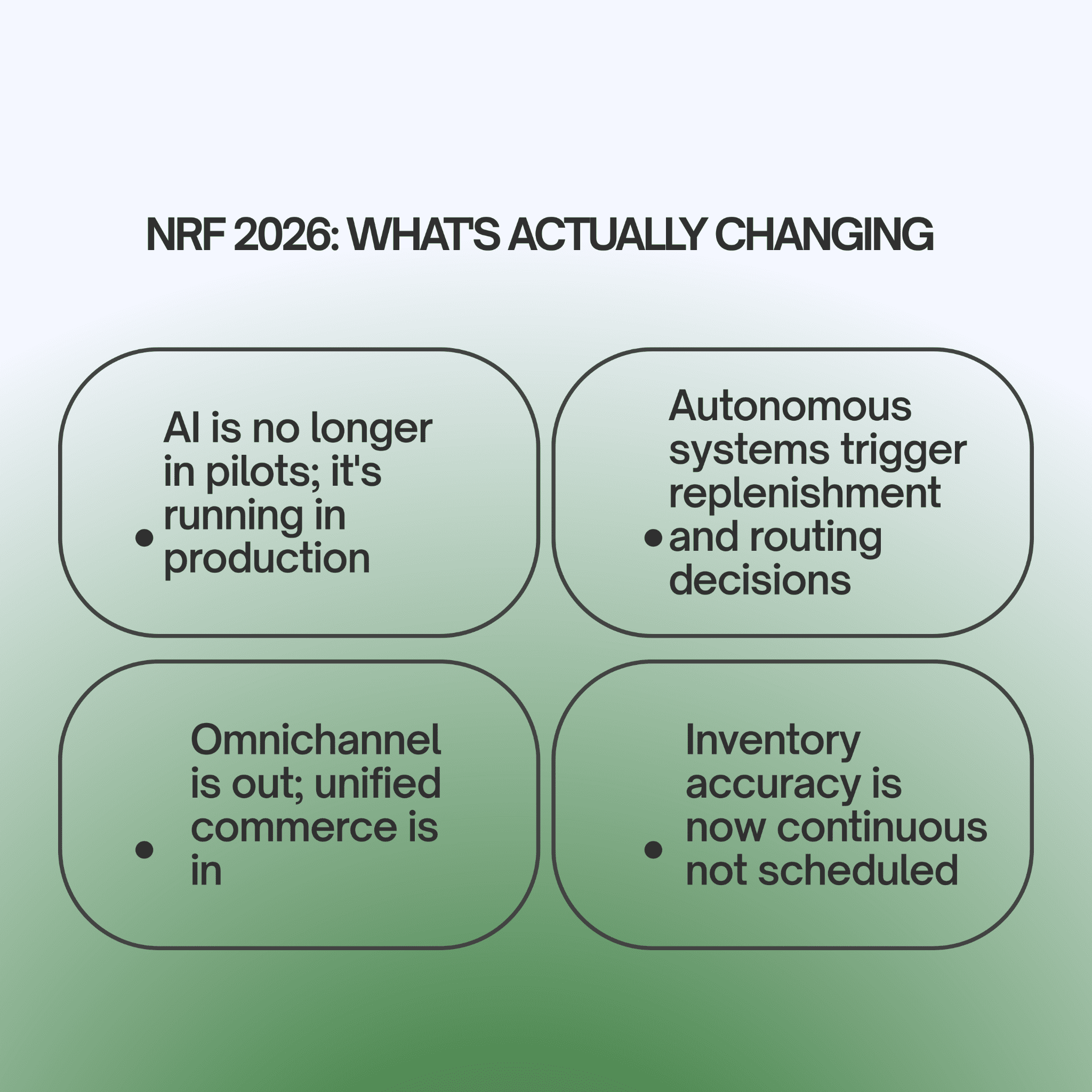
The most meaningful shift at NRF was not the presence of generative AI, but its role. Retailers are embedding autonomous decision-making directly into core workflows rather than layering AI on top of existing processes.
Instead of generating recommendations that require human review, systems are initiating replenishment, adjusting labor allocations, and rerouting fulfillment based on live conditions. The operational benefit is speed and continuity. Insights no longer wait in dashboards for action. They trigger action.
This collapses a chain that has long slowed retail execution: analysis, approval, handoff, implementation. When systems move directly from signal to execution, teams stop optimizing functions in isolation and start optimizing outcomes.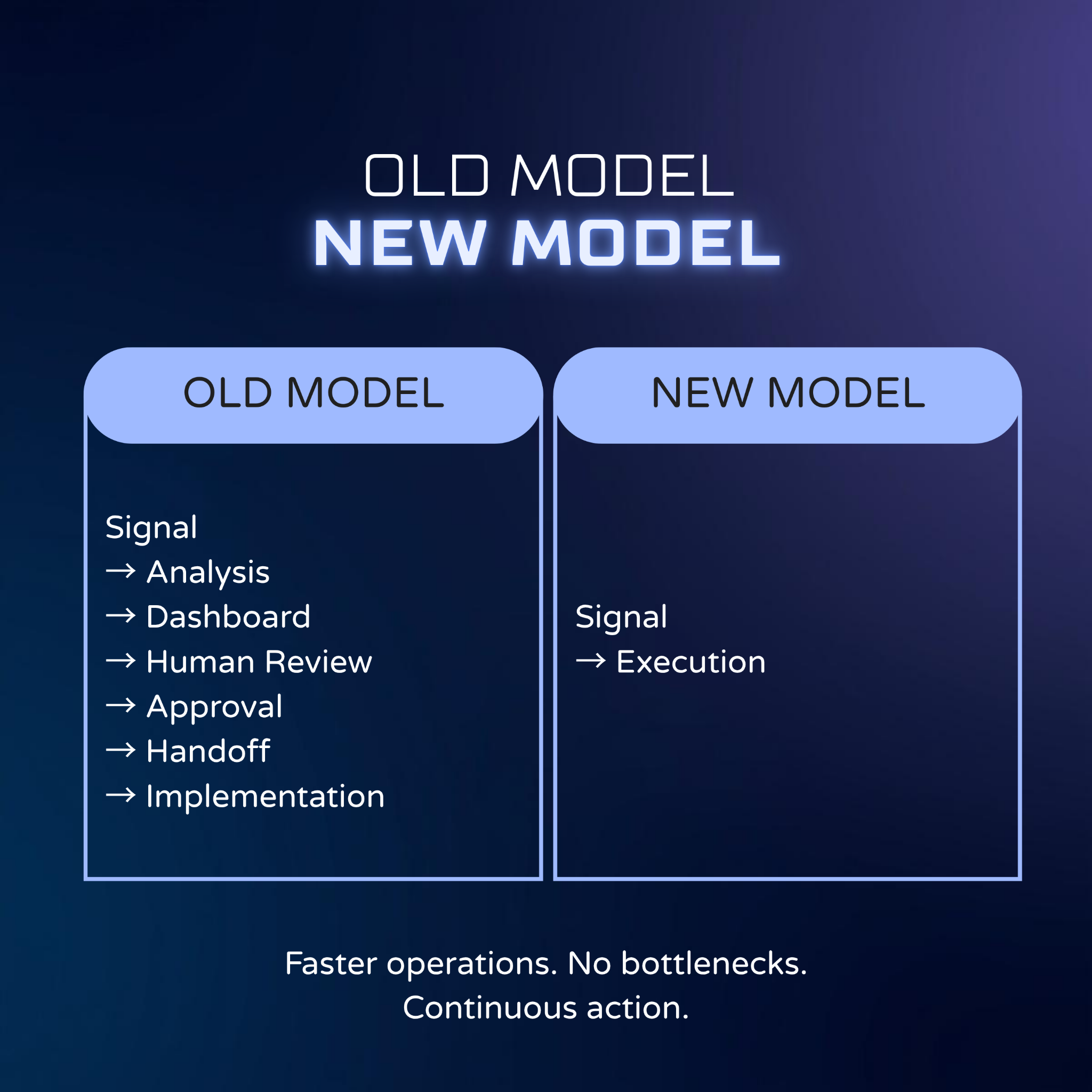
Unified Commerce as Foundational Infrastructure
Operators have quietly moved on from the term “omnichannel.” What replaced it is a more pragmatic idea: commerce as a single, interoperable system.
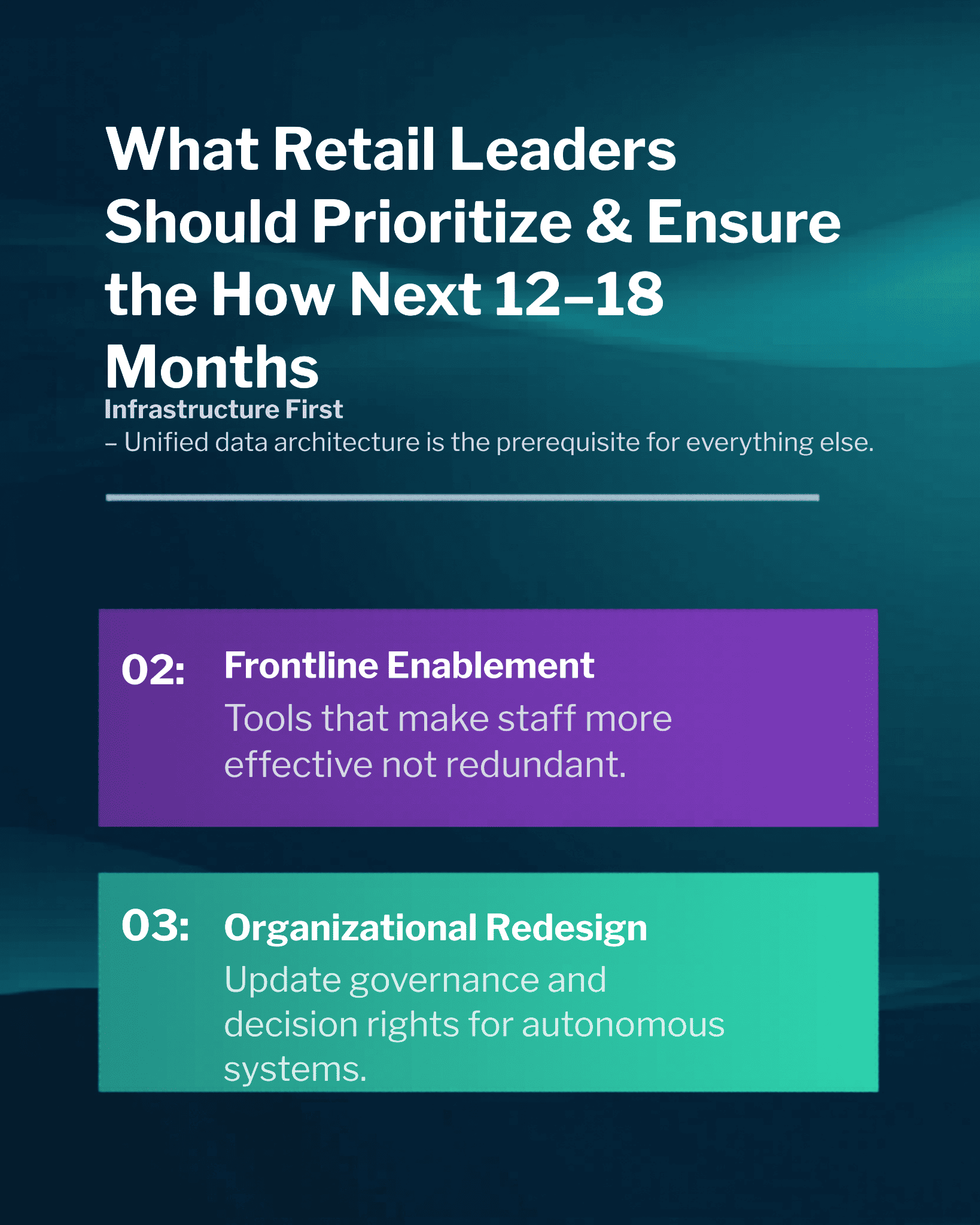
Stores, warehouses, and digital touchpoints are being treated as nodes in a unified fulfillment and inventory grid. This shift isn’t driven by experience design; it’s driven by operational necessity. You cannot route orders, manage exceptions, or automate replenishment if systems don’t share a common data model.
Initiatives like the Universal Commerce Protocol reflect this reality. They are less about innovation and more about formalizing what large retailers have already built internally: infrastructure that allows agents, human or automated, to transact across environments without brittle integrations.
Home improvement and grocery operators highlighted a critical dependency here. Product data consistency is no longer a marketing concern. It’s an operational requirement. Without complete, structured data, automation breaks down before it starts.
Inventory Accuracy Without Theater
Inventory management is moving from episodic counting to continuous verification.
Instead of annual audits or scheduled cycle counts, retailers are prioritizing inventory checks dynamically based on velocity, shrink risk, and revenue impact. Associates perform lightweight scans as part of existing routines using familiar mobile devices. Algorithms decide where attention is needed.
The operational consequence is fewer emergency replenishments, fewer last-minute substitutions, and less manual exception handling at the store level. Inventory accuracy becomes a background process rather than a disruptive event.
This is inventory management reimagined as a continuous background process rather than a scheduled event.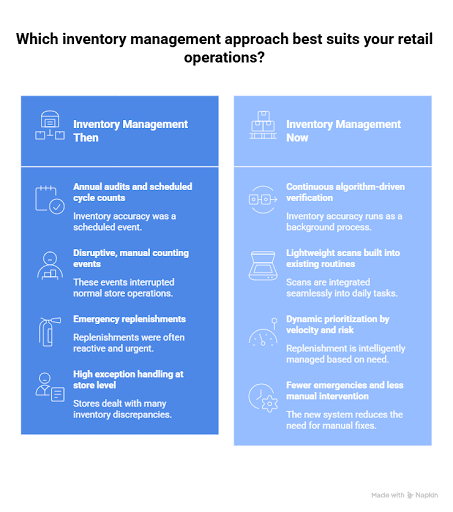
Store Automation That Doesn't Scare Staff
A recurring theme at NRF was “quiet tech.” Automation designed to fade into workflows rather than dominate them.
Associates interact with tools that resemble consumer apps, visual guidance, familiar gestures, minimal training. The goal is not replacement, but leverage. Automation absorbs repetitive cognitive load so staff can focus on exceptions and customer interaction.
In a constrained labor market, adoption matters as much as capability. Tools that require retraining or disrupt established routines face resistance. Tools that feel intuitive earn trust quickly.
Content Generation as Infrastructure, Not Marketing
AI-generated content appeared frequently, but the framing has shifted. This is no longer about copy quality. It’s about scalability.
Retailers are using AI to generate and maintain consistent product data across millions of SKUs. That data feeds search, recommendations, fulfillment logic, and store operations. Manual creation cannot keep pace with catalog growth or channel expansion.
Leaders should treat this as infrastructure investment. The value comes from making product data usable everywhere, not from marginally better descriptions.
Experiential Retail Backed by Operational Rigor
The store-as-experience-center isn't new. What's new is treating it as an operational model supported by automation rather than a staffing-intensive aspiration. Retailers are using AI to analyze foot traffic, personalize in-store interactions, and optimize layouts; while using the automation mentioned above to free staff for those higher-touch activities.
This works when the back-end is efficient enough that the front-end can be human. NRF sessions stressed the balance: automation handles the mechanical, humans handle the meaningful. But that balance only functions if systems are reliable and staff aren't drowning in operational busywork.
The shift represents a pragmatic acknowledgment. Customer retention matters. Labor is expensive and scarce. Technology can create the conditions where human interaction adds value instead of just keeping the operation running.