

Our Services
All the solutions you need to accelerate growth and drive business success.
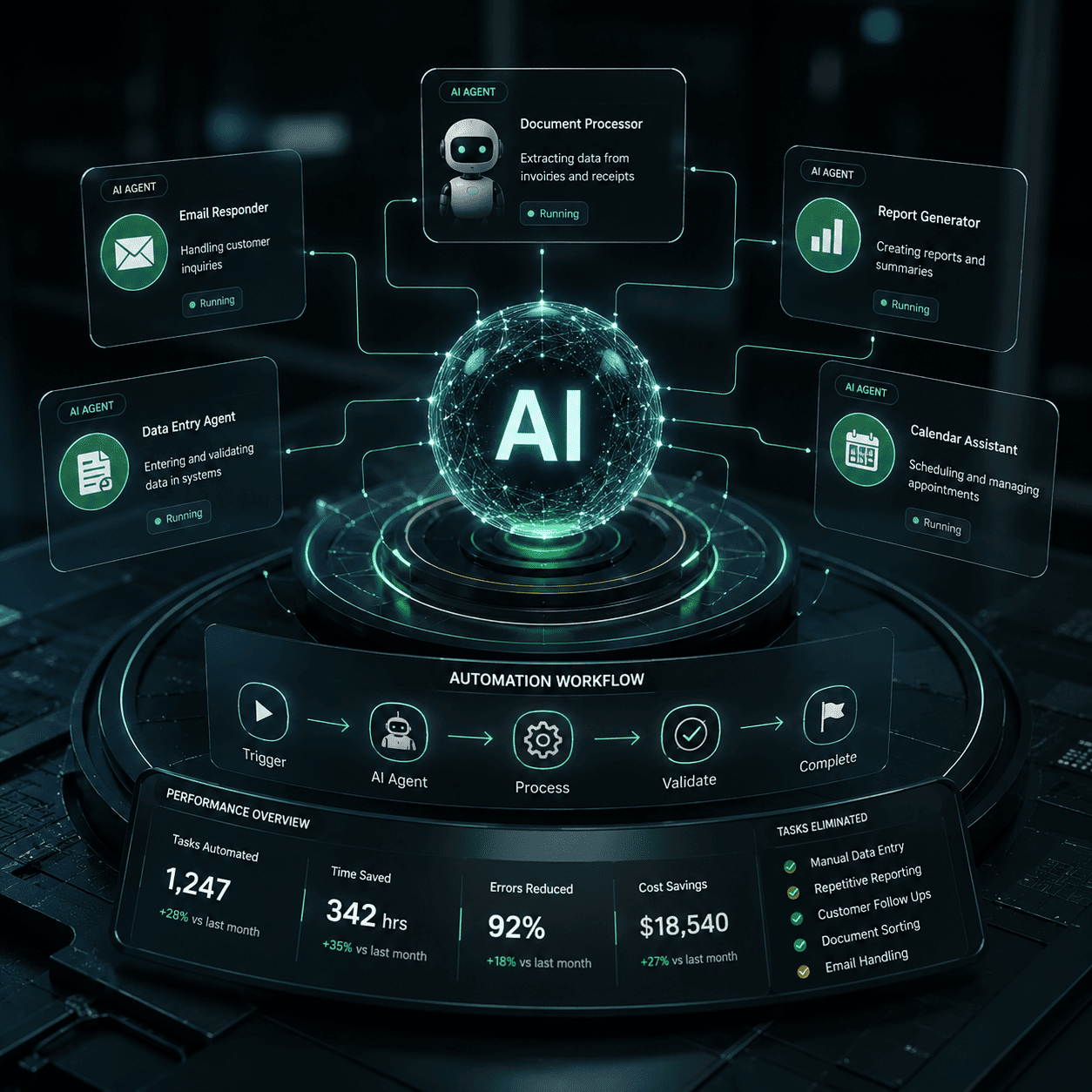
Custom AI agents for real business workflows
Generic AI tools often fail because they don't understand your unique business context. We build specialized agents that integrate directly with your existing software stack, databases, and communication channels to execute complex multi-step processes autonomously.
What custom AI agents help you eliminate
Eliminate repetitive manual tasks
Eliminate process bottlenecks
Eliminate delays caused by disconnected workflows
Eliminate unnecessary handoffs across teams
Built by department
Tailored intelligence designed for the specific challenges of your functional teams.
Customer Service
Automated ticket triaging
Instant multi-lingual support
Knowledge base synthesis
AGENT EXAMPLES
Sales
CRM data enrichment
Automated lead qualification
Sales sequence optimization
AGENT EXAMPLES
Marketing
Dynamic content generation
Campaign performance analysis
SEO trend monitoring
AGENT EXAMPLES
Finance
Automated invoice processing
Expense auditing & fraud detection
Real-time budget forecasting
AGENT EXAMPLES
HR
Candidate screening & ranking
Employee onboarding automation
Policy FAQ support
AGENT EXAMPLES
Operations
Inventory optimization
Logistics & routing automation
Vendor management workflows
AGENT EXAMPLES
How it works
Identify opportunities
We audit your current workflows to find the highest impact areas for automation.
Design and build
Our engineers construct custom LLM-powered agents integrated with your core systems.
Launch, refine, and improve
We monitor performance, gathering feedback to continuously iterate and polish efficiency.
Specialized Agent Types
Research Agents
Gathering and synthesizing complex data from across the web.
Analysis Agents
Extracting actionable insights from messy unstructured data.
Integration Agents
Connecting disparate SaaS tools to trigger seamless actions.
Customer Agents
Intelligent conversational interfaces for support and sales.
Compliance Agents
Automating the monitoring of regulatory and security standards.
Content Agents
Generating brand aligned copy across multiple formats.
Why leading businesses choose Dotlogics

Strategic Alignment
We don't just build technology; we build solutions that solve specific revenue and operational challenges.
Full Stack Integration
Our agents plug into your existing ecosystem—Slack, Salesforce, SAP, and proprietary databases.
Enterprise Security
Built with SOC2 compliance in mind, ensuring your proprietary data never leaves your secure environment.
Scalable Architecture
Start with one agent and scale to an entire workforce of autonomous digital employees.
Human In The Loop
We design governance models where humans remain in control of the most critical decisions.
Proven ROI
Our implementation methodology is focused on delivering measurable hours saved from week one.
Frequently Asked Questions
Clear answers to common questions about implementation, integrations, and how our solution fits your business. Still have questions? Feel free to contact our support
Typically 4 to 8 weeks depending on the complexity of the integrations and the specific workflow logic required.
No, we provide a management interface and ongoing support so your business users can monitor and refine agent performance.
Never. We use private instances and enterprise-grade APIs where your data is strictly siloed and never leaked to training sets.
We build in Human In The Loop validation for high stakes tasks, ensuring agents flag edge cases for manual review.
Yes, if your software has an API or an accessible database, our agents can be configured to interact with it.
We typically operate on a build fee followed by a monthly performance and maintenance license based on usage volume.
Custom AI agents are intelligent autonomous software systems built specifically for a company's unique workflows. Unlike generic AI tools, custom AI agents integrate directly with existing software stacks, databases, and communication channels to execute complex multi-step processes automatically — eliminating manual work and improving team efficiency.
Dotlogics builds custom AI agents for customer service, sales, marketing, finance, HR, and operations teams — including agents for ticket triaging, CRM enrichment, content generation, invoice processing, candidate screening, and inventory optimization.
Typically 4 to 8 weeks depending on the complexity of the integrations and the specific workflow logic required.
Yes. Dotlogics uses private instances and enterprise-grade APIs where proprietary data is strictly siloed and never leaked to public AI training sets. All agents are built with SOC2 compliance in mind.